
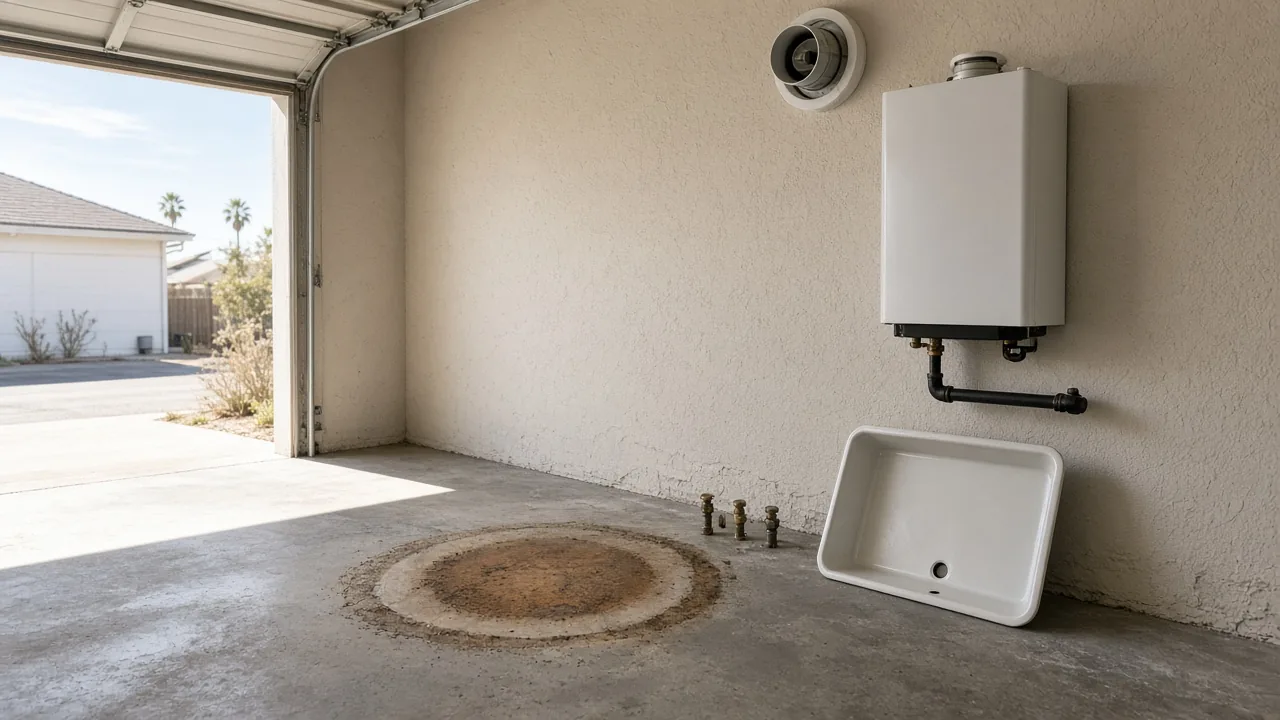
Converting a tank to a tankless water heater in Riverside means removing the storage tank and installing a wall-hung unit with the venting, gas or electric service and permits that the new appliance needs. It is a different path from a like-for-like tank replacement and from hanging a new tankless unit where one already exists. Inland houses often have the old tank in a hot garage, and the gas line that fed it may be too small for a high-BTU tankless model.
Why people convert
A tankless unit can free floor space, supply continuous hot water when it is sized correctly, and avoid a tank that rusts through in hard water. Those are real advantages, not guarantees. The house still has to support the gas load, the vent path and the maintenance that hard water demands. Read tank versus tankless before you decide.
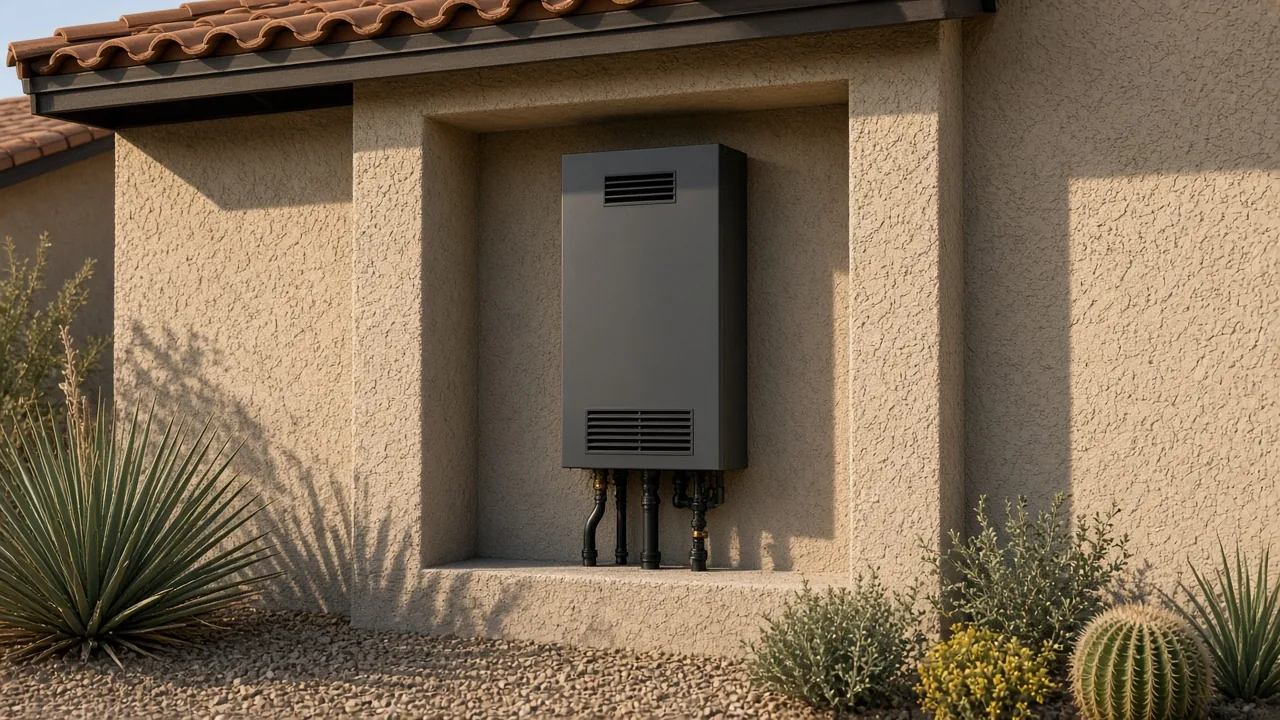
What usually has to change
The tank comes out, including the vent and the seismic straps that no longer apply in the same way. A new vent or concentric termination is installed. The gas line and meter are checked for capacity. A condensate drain may be added. Isolation valves should be included so the unit can be descaled later. Electrical service is needed even on a gas unit, because the controls and fan need power.
Rather explain it out loud? One call covers it.
Call 000 000 0000Permits and plan review
Do not assume a conversion is an over-the-counter change-out. The City of Riverside lists simple water heater change-outs among over-the-counter examples issued on the day of application, but a fuel, vent or location change can require plan review. The provider should confirm the current Building and Safety path. Other cities have their own rules.
Hard water after the conversion
A new tankless unit in Riverside will still see very hard groundwater. A conversion that skips isolation valves or a maintenance plan is trading one problem for another. Ask about descaling before the unit is hung.
When a new tank is the better fit
Some closets, some manufactured homes and some gas services are a poor match for a conversion. A properly strapped, permitted tank replacement can be the more straightforward job. The call is a good time to compare both, without invented prices.
Tank-to-Tankless Conversion in Riverside neighborhoods
From Arlington Heights along Victoria Avenue, Canyon Crest, the Magnolia corridor, tank-to-tankless conversion is a regular request. Blocks near Victoria Avenue, the roughly seven-mile historic divided avenue of palms, eucalyptus and roses, listed in the National Register of Historic Places, mix closets and garages. Streets closer to the Parent Navel Orange Tree, the historic navel orange tree at Magnolia and Arlington, tied to California's Washington navel industry, include later hillside or tract houses where access is easier and skipped tankless maintenance is still common. Official orientation includes Landmarks of Riverside and Landmarks of Riverside. Permits inside the city start with City of Riverside Building & Safety permits page. Check a contractor with the Contractors State License Board guide to hiring a contractor.
Conversion is a Riverside project, not a swap
A tank-to-tankless conversion in the City of Riverside almost always changes more than the appliance. Gas lines, vents, combustion air, electrical service and the permit path are the usual extras. Do not assume the job is a simple change-out that can be issued over the counter on the day of application. The permits page and the water heater handout are the official starting points.
Tight downtown and Victoria Avenue garages sometimes favor keeping a tank because the existing vent and gas already work. A later tract garage may have the wall space and still lack the gas capacity. Hard water does not forbid a conversion; it adds a descaling habit the day the new unit is lit. Ask the provider to talk through both a high-quality tank replacement and a conversion, with the house in mind, not a brochure.
Have a sense of how many fixtures may run at once and whether the house already has a recirculation line or an expansion tank. Those details do not decide the job by themselves, but they stop the conversation from staying at the level of a catalog photo. If the garage is tight, measure the wall you hope to use and mention nearby windows or meters. The honest alternative remains a well-installed tank replacement, and you can ask for both scopes on the same call.
Before you call: what to have handy
- Current tank size, fuel and location
- Household hot-water use
- Whether you have a preference for indoor or outdoor placement
- Any HOA or rental rules
- Your Riverside address or nearest cross streets
How a call about tank-to-tankless conversion works
- Call the number on this page and describe what the heater is doing.
- Share your Riverside address or nearest cross streets, or name a nearby city, and ask whether your address is covered. Nothing is promised in advance.
- Ask the provider what a visit involves, how pricing works and whether a permit applies. Prices are set by the provider, not by this site.
Nearby cities
The same line takes tank-to-tankless conversion calls from Corona, Moreno Valley, Jurupa Valley, Norco, Eastvale, Perris, Lake Elsinore, Colton. Your exact address is confirmed on the call. Nearby cities use their own permit offices and water reports.