
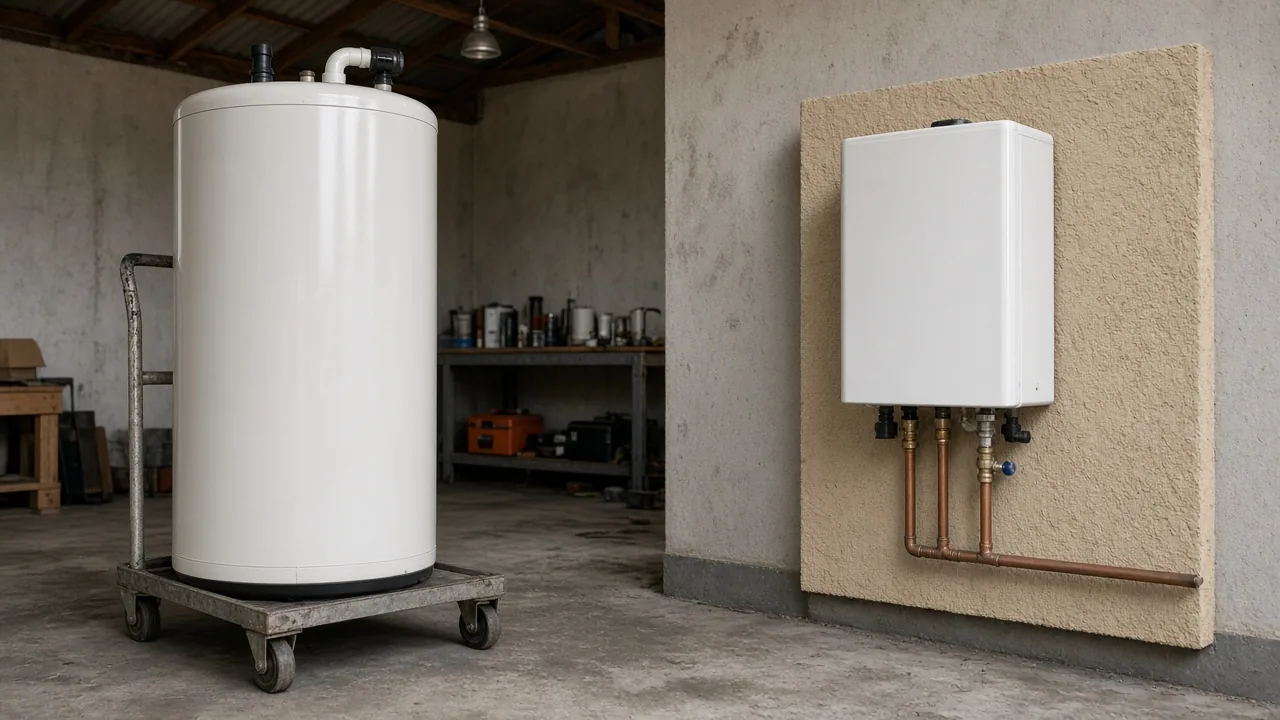
Choosing a tank or a tankless water heater in Riverside, CA is a house decision, not a trend decision. A new tank is the simpler swap in most garages and closets. A tankless unit can free floor space and supply continuous hot water when it is sized correctly, but it often needs a larger gas line, new venting and a descaling habit that matches this city's hard water.
What a tank does well
A storage tank is familiar, parts are easy to get, and a like-for-like replacement can stay close to the existing footprint. You still have some hot water after a brief power interruption. The downsides in Riverside are real: sediment from hard groundwater, a tank that rusts through, and a bulky appliance in a tight garage that also has to be strapped and protected from a car.
What a tankless unit does well
A wall-hung unit heats water as it flows. When it is sized for the house and the incoming water temperature, it can run a long shower without the tank going cold. It takes less floor space. The trade-offs are electrical dependence, more demanding venting and gas service, and mineral scale on the heat exchanger. Official hardness around 12 grains per gallon makes descaling a regular job. See tankless installation and tank-to-tankless conversion.
Rather explain it out loud? One call covers it.
Call 000 000 0000Garage heat
Inland summers bake attached garages. Both tanks and tankless units have to be listed for the space they occupy. Some tankless models prefer an exterior wall. A tank still has to meet the 18-inch burner rule in a garage unless it is listed FVIR. Read garage water heaters and summer heat.
Permits
A simple tank change-out in the City of Riverside may be an over-the-counter permit. A conversion often is not. Confirm with Building and Safety. Other Inland Empire cities have their own departments. See permits.
ADUs, condos and manufactured homes
A small accessory dwelling may do well with a smaller tank or a point-of-use or properly sized tankless unit. Closets in shared buildings and manufactured-home listings have extra rules. See ADU water heaters and manufactured-home heaters.
How to decide on the call
Have your current fuel, the location, how many people use hot water at once, and whether you are trying to keep a tank or move off one. The provider can talk through both paths. This site does not quote prices or claim that one type always lasts twice as long in Riverside water.
Fuel, gas lines and electrical service
Most older Riverside houses with a gas tank already have a gas line and a Type B vent or an equivalent path. A tankless unit often wants more gas than that line can supply, plus a different vent, usually a concentric or two-pipe system out a wall or roof. An electric tank swap is simpler electrically than a whole-house electric tankless unit, which can demand a large panel upgrade. A heat pump water heater is a third electric path and has its own space and condensate needs; see the heat pump guide.
None of those facts mean a tankless unit is "too hard" for Riverside. They mean a conversion is a project, and a like-for-like tank replacement is usually the shorter path.
Household use, not brochure use
A tank stores a limited volume and then recovers. Two showers, a dishwasher and a laundry load at once can empty it. A tankless unit is limited by flow and by incoming water temperature. Inland winter groundwater is cooler than a coastal summer main, so the same unit may deliver less flow here in January than a national brochure implies. Sizing belongs to the provider, with your fixture count and your actual incoming temperature in mind.
Maintenance compared
A tank in this water wants periodic flushing and an anode check, plus working straps and a T&P drain. A tankless unit wants regular descaling, a clean inlet screen and a combustion path that stays clear. Skip either list and the appliance fails earlier than the owner hoped. Hard water does not "forbid" tankless equipment. It forbids neglect.
Space, noise and location
A tank takes floor space and must be strapped. A tankless unit frees that floor but occupies a wall, needs listed clearances and may be louder at full fire than a tank at rest. Outdoor tankless units avoid a packed garage but need a proper termination. Historic or tight downtown garages sometimes favor a compact tank because the gas and vent already exist. A newer tract garage may go either way.
Cost talk without invented prices
Installed cost, operating cost and replacement cost all differ, and this site will not invent figures. A tank replacement is often the lower first cost. A tankless unit can cost more to install once gas, vent and permits are included, and it may save operating cost if it is used and maintained well. Ask the provider for a written scope, not a slogan.
A decision you can make on the call
If the current tank is leaking or the tankless unit is throwing scale-related codes, the first question is often repair versus replace, and only then tank versus tankless. Have the age, fuel, location and your preference ready. Read permits if the project might be more than a simple change-out, and hard water and scale if maintenance is the open question.
Talk it through by phone
Call the number on this page if you want to talk through how this applies to your heater and address. Have the city, the fuel and the location of the unit ready. Coverage is confirmed on the call.
Sources checked
Reviewed November 17, 2026. Confirm anything important with the agency, since rules and programs change.